By Olly Johnson
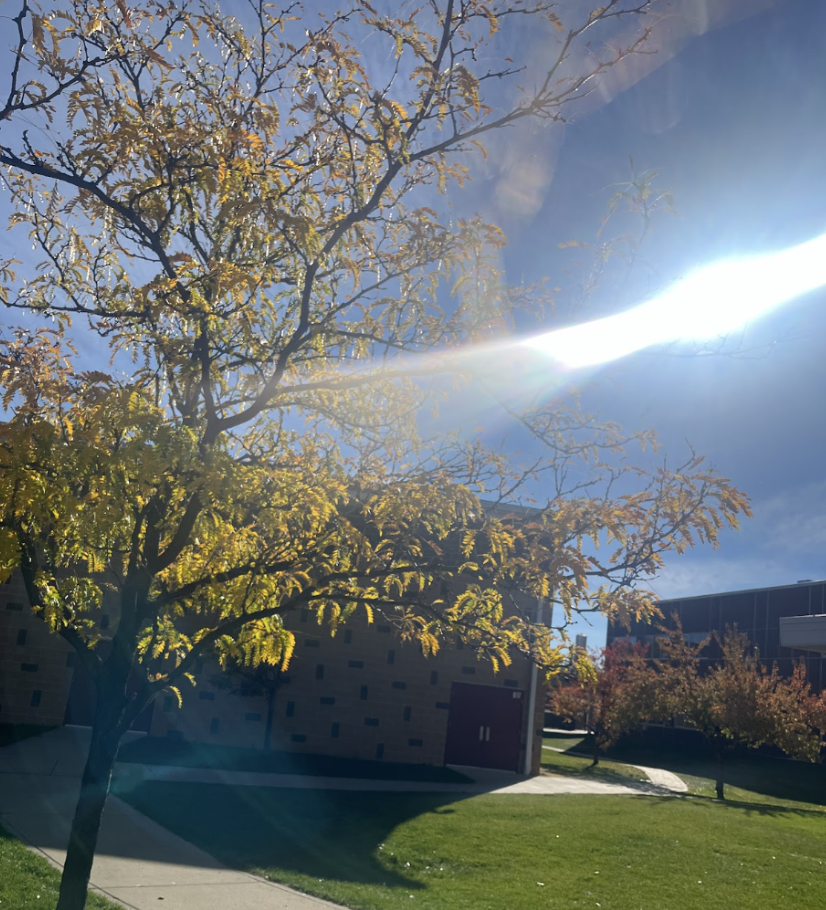
At the time of writing this, it is the middle of Autumn, the season of cool weather, falling leaves, brisk mornings, festivities, and early snows. Fall is one of the more popular seasons of the year for a reason. However, if you were to check the weather this year, instead of finding temperatures in the mid-50s or low-60s with a chance of snow, you’d find temperatures in the high 70s and even mid-80s with little to no precipitation. This is in conjunction with brisk mornings, leading to Colorado morning temperature to be, at a minimum, 30°F cooler than the afternoon. Yet, Colorado is not alone in this issue. Almost the entire United States is experiencing record-high temperatures. And if the state is not breaking the record every day, the state is experiencing storms on an unseen scale.
According to the National Integrated Drought Information System (N.I.D.I.S.), all the states are experiencing hotter temperatures than usual with Colorado and all of our neighboring states like Wyoming and Nebraska being over 8°F higher than what it usually is. With this hot weather, it’s no wonder that drought conditions are also being experienced in the United States.
N.I.D.I.S. shows that all the states, excluding the Deep South, such as Florida and Georgia, have some drought conditions. Admittedly, most of the droughts are either Abnormally Dry, the stage that is directly before or after a drought, also known as D0, or Moderate Drought, known as D1. The only places in the states that are experiencing the most devastating droughts, known as Exceptional Drought or D4, are West Texas and a small part of Eastern Ohio. Taking this even further, the hotter temperatures are causing droughts, and droughts are causing a different issue: forest fires.

Forest fires need no introduction. A memorable one occurred on Lookout Mountain back in September of 2024, so it’s not foreign to us in the slightest. Stating that forest fires are bad for the environment is the equivalent of saying that smoking is bad for your health. It’s a given. However, the rising temperature rate brings an interesting pattern to light. The National Interagency Fire Center (N.I.F.C.) keeps track of forest fires, having records for fires between the first of January and the 23rd of October dating back to 2014. Between those days, 2024 had 44,571 forest fires in America, which is on the low side of fire counts, being the third lowest number of fires over the ten years.
Despite this, the year’s fires burned down the fifth most acres of land at 7,944,344 acres. To put that into perspective, Denver is 155 square miles, or 99,200 acres of land. This means that you need a little over 8o Denvers to fit all the wildfires that occurred this year, and that is on the low side of acres burned.
However, perhaps we in Colorado are lucky enough to be hit with a weaker side of the blade, as we could be down in the Deep South. Not only did the panhandle of Florida get hit by Category 4 Hurricane Helene, but almost immediately after, it was hit by, at its strongest, Category 5 Hurricane Milton across the entire peninsula. This is a rare occurrence of two hurricanes hitting back-to-back in the span of a couple of weeks. However, this event has happened before. In fact, 2024 marks the 20th anniversary of the 2004 hurricane season where five hurricanes hit the state in six weeks. The main difference between the 2004 Hurricane quintuple and the 2024 double is the intensity. Sure one of the hurricanes in 2004, specifically Hurricane Charley, was a Category 4 when it hit Florida. However, Hurricane Milton was so large and powerful that it could be seen from space. The last Category 5 hurricane was back in 2018 Hurricane Michael. Even then, it could be argued that Hurricane Helene is the stronger of the two due to where it hit. Hurricanes can cross over land, but they quickly die due to the lack of water. Hurricane Helene was different. It went straight North, going all the way to Indiana before dying off. The hurricane cut through mountains as it went north, hitting small mountainous towns. These towns were practically cut off from the entire world, as the hurricane destroyed power lines, cell towers, and even roads. The only way to bring supplies into these small towns is by helicopter.

All these events happening around the same time leave one lingering question: Why? It’s easy to point at climate change because it is part of the answer. However, leaving it at climate change leaves a lot of unanswered questions. There are massive cold and hot fronts, called La Niña and El Niño, that circle around the Atlantic Ocean. They swap hemispheres every year, so there is a cold front one year and a hot front the next. This year is El Niño, so it makes sense why it would be a little hotter than last year, but not by this much. This extremity of El Niño even applies to La Niña. Last year, La Niña was the cause of a cold summer here in Colorado, where it snowed in June. So, is there anything we can do about this? Of course, we need to change. But how do you bring about it? Maybe we could all focus on one effort to slow the effects of climate change. Who knows, the weather of today will be the reason for change in the future. One thing is for certain though, the weather is not normal, and it won’t go back to normal if nothing is done about it.







 The Golden Trident
Leave a comment