By Kieran Ambrose
Are all athletics linked to brain damage, or are certain sports more naturally dangerous?
Young high school and college athletes involved in certain sports may have experienced a dangerous amount of concussions before their brain is fully developed. There is also a risk of death upon receiving a subsequent concussion if you gain a brain bleed. Brain bleeds can be very deadly and even if you survive one, you may never fully recover. As they and any other brain/spine injury can leave some in a coma or paralyzed.
So why do so many sports predominantly played by teen boys lead to these conditions? The answer is head-on collisions and falls with unpredictable landings. The biggest causes of these injuries are football, hockey, and lacrosse. These sports also have the common factor of very extreme and aggressive collisions and a heightened level of physicality. These sports are more physically demanding and physically damaging than other sports, so it’s almost expected to result in more concussions,which is why we may need to regulate the amount of head injuries someone can have going into one of these sports.
So is all of the heightened fear towards this warranted or is it fear generated by a minor injury? Well, concussions have other risks besides brain bleeds. Chronic Traumatic Encephalopathy is a recently discovered condition that various football players may have. One major issue with determining the condition is that it is almost impossible to confirm while someone is alive. This has led to many football players who are commonly believed to have CTE, although we won’t know for sure for years. There have been incidents over the years involving players committing suicide due to mental issues, mainly based on this ailment but also to spread awareness of it. Some famous people with CTE include Aaron Hernandez, who committed suicide in prison and was found to have the aforementioned upon death, and Junior Seau who also took his own life and was diagnosed with CTE postmortem. There have been countless others who commit suicide, likely as a result of this disease. Athletes like Junior Seau killed themselves directly due to CTE, but why did it take all of these men’s deaths just to give them a diagnosis once they were already dead?
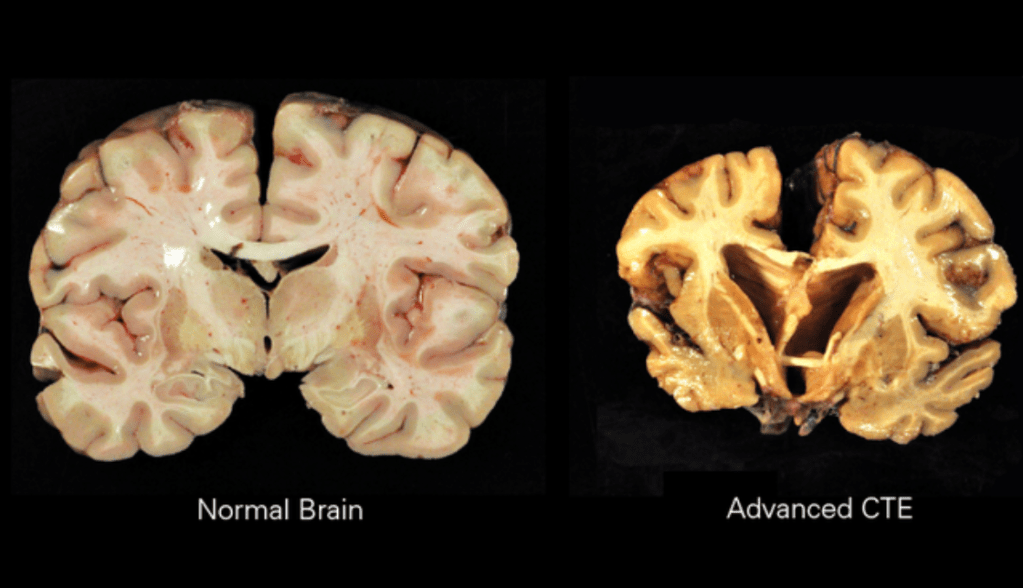
CTE has only in recent decades become an affliction commonly discussed by national media. For example, in 2007 a high-profile article written by the New York Times reported that Andre Waters had killed himself due to CTE. CTE research has only started in the past couple of decades, so why can’t people be diagnosed until they have passed away? Well CTE isn’t just an acronym, it’s a condition of degenerative brain disease caused by repetitive head trauma. The symptoms that are often found in CTE patients are memory loss, depression, aggressive behavior, as well as suicidal thoughts. The symptoms may make themselves known far after the initial injury has occurred due to CTE being a degenerative disease, which progresses over time. CTE progresses in stages, but to understand CTE you need to understand how it does that. In the brain, there is a naturally occurring protein called Tau. When a person gets CTE, they start to build up an excess amount of Tau which clumps up, strangling brain cells. Dr. Ann Mckee of the CTE Center of Boston College developed a staging system for CTE.
These stages are mild (1) to severe (4), but the symptoms tend to not be linked to specific stages which also increases the struggle to identify CTE in living patients. Because the lesions( a area of skin/tissue that is damaged/ has irregular irritation/swelling.) in the brain caused by CTE are microscopic, meaning that they are even harder to identify, the location of the lesions caused by CTE can be very important. Some lesions can cause little to no issue but a lesion in your frontal lobe or other crucial parts of the brain can be very impairing and far more severe.
Stage one is the most common and the lesions will usually be in the frontal lobe. Symptoms in stage one are limited and the most common is memory loss. Stage two is when the lesions spread to nearby areas of the brain, and this tends to result in more severe memory loss as well as worse concentration and struggles with impulse control. Stage three is where patients tend to have many more visible changes such as violent tendencies and paranoia. This happens due to the lesions spreading to the hippocampus and the amygdala. Stage three’s symptoms may sound familiar if you watch football or are familiar with cases like Aaron Hernadez, Aaron Hernandez was postumistiously diagnosed with stage three CTE. Stage four occurs when the lesions have spread to multiple parts of the brain. Because of the aggressive and advanced nature of stage four CTE, it has become common to have a patient diagnosed with dementia. The time it takes for CTE to progress between stages is typically 10-12 years, meaning CTE patients over 50 are likely to be stage three or four. Sadly, there is no cure for CTE, and it also is not only a hindrance in the lives of pro football players. Two years ago, a student-athlete suffering from CTE, Wyatt Bramwell of Nashville, Tennessee, took his own life, and two years later researchers at Boston University discovered he was suffering from CTE. This is the first confirmed case of CTE in a high school football player.
There is a significant difference between NFL players getting CTE through a long career in football and a high schooler who suffered from it. It should be a major cause for concern, we may very well see more people who developed CTE around the same age because we can’t accurately tell if someone has CTE until after they have passed. It will likely take a long time before we know how many people have developed CTE, not only from pro football but collegiate level players, as well as high school players. CTE’s effects will likely not only be in the future of football but in other high-impact team sports as well. Many believe it will be hard to implement any real changes to help with safety in high school football mainly because football is already expensive for schools. There are things like the “Guardian cap” which is an external pad that goes on a football helmet. Guardian caps are seemingly effective at preventing and reducing the severity of concussions. Although guardian caps are helpful, it’s rare to see them in use outside of football practices, meaning in games athletes are still just as likely to sustain a brain injury.
The NFL and NCAA should implement a mandatory limit to the amount of concussions a player may sustain while in the league. Again, this is also likely something we won’t see any time soon (if ever) because it could cause players and coaches to hide the amount of concussions a player has sustained. It also would go against the monetary interest of the league as they would likely be reluctant to axe players who could be bringing in lots of money for their franchise. At the end of the day, we need to be more careful with football and other high-impact team sports, and we also need players to know when it’s their time to call it quits on the field. Most precautions that can be taken have already been put in place and it’s now just up to parents, coaches, and players to try to minimize injuries.







 The Golden Trident
Leave a comment