By Jax Mckinnon
Photos courtesy of Martha Worth and Zeke Fiber
Modern circus is seen as the pinnacle of live entertainment. It is exhilarating family fun, filled with high-flying acrobats, clowns, and cotton candy. These showcases of high-energy talent aim to inspire and excite you. However, culture within these troupes of acrobats is much more than tricks and flips. I started circus in 2022 doing aerial silks and was quickly roped into this captivating art form. Only through being in this tight-knit community have I found the nuance in circus arts, allowing me to explore all it has to offer.
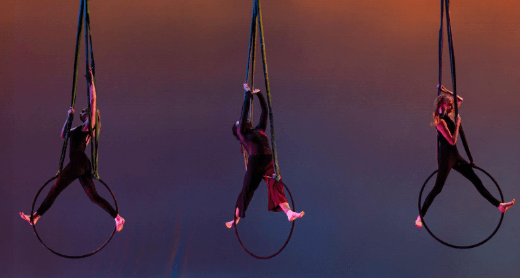
While I train in a plethora of disciplines, I predominantly train in aerial arts, a type of acrobatics that relies on the manipulation of an apparatus with one’s body in the air. The most commonly known are trapeze, silks, and lyra. It is a physically challenging art that routinely forces me to challenge the relationship I have with my body. As a trans person I am forced to wear clothing I normally wouldn’t choose to wear because of the nature of the practice. Baggy clothes get stuck and restrict my movement, making tight well-fitting clothes my best option. Therefore, I am routinely forced to feel some level of discomfort. It’s often a challenge to navigate where my boundaries lie, and how long I can train before the feeling of discomfort is no longer bearable. However, I can take this discomfort and play with it, discovering ways around larger clothing, and figuring out ways where I can effectively train while also feeling good. It took me a while to learn that I could experiment with this instead of simply avoiding it. Meeting queer coaches introduced me to this concept of playing with my comfort and limits on my gender.

Circus arts is a tight-knit community, allowing you to gain access to a lot of people without personally having to meet them. I’ve met people out of state who know everyone at my studio. This makes it incredibly easy to gain access through mutuals on things like programs, studios, and shows. I found out about a youth program called Circus Smirkus from one of my friends who tours with them every year. Through this program, I was able to expand my network outside of circus artists in Colorado, meeting some truly incredible people.
I was fortunate enough to attend Circus Smirkus’ three-week, intensive circus camp over the summer in Greensboro, Vermont. Here, I met a coach, Izzi Kessner, who encouraged me to challenge my relationship to my gender in my practice. Kessner uses they/them pronouns and is a student at ENC (École Nationale de Cirque) in Montreal, Canada. Kessner’s approach to circus helped me start to question my own relationship with my practice regarding how my mindset of my gender was affecting it, and vice versa.

During this camp, I was put in a piece coached by Kessner, called acro research. This is a form of ground acrobatics that focuses on challenging the technique that’s taught in floor acrobatics and tumbling, encouraging one to find new and “odd” movements. This pushed me into a territory where I was not confident in the way my movement looked or in my physical ability to execute it properly. Kessner also hosted sessions they called “Circacademics”, where they challenged us to think critically about our relationship to our apparatuses, the audience, and ourselves, leading me to some valuable conclusions. I realized the performance aspect I chase the most is my own praise, and I was performing so I could feel good about myself as an artist. However, I realized I was simultaneously withholding that praise from myself by keeping an unrealistic everchanging image of what “good” is supposed to look like. My relationship with my performance was becoming toxic as I thought that everything I did could have been better if I had just tried harder. The odd and unconventional training style I was exposed to made me realize I was training for the wrong reasons. It let me realize that my body and mindset didn’t get along and I needed to fix something to make them agree. I had to figure out what part of me was always pushing and what part didn’t recognize that.

The three weeks of physical and mental exertion over the summer showed me why I was truly performing, and I decided I wanted to change my motives. Instead of training and performing for the idea of being “good,” I wanted to test boundaries and learn new things. For the first time in a while, I simply wanted to create, and explore. Coming back from the summer, I was tasked with making an audition piece for the company I perform with. I have been in this company for a few years, therefore the audition was only a formality so I had total creative freedom with it. I went through phases of exploration and research with my apparatus, finding ways to use it that I had never seen or tried before. I was doing tricks specified for one apparatus on another and I loved it. I wanted to break down my previous view that my performance had to be “good” and just focused on creating. Although my final product demanded more time to be assembled properly, I still performed it. I would’ve liked to have a longer phase where I could gruel over the details, and dissect my motives for the act. Nonetheless, it was something I had made through a process of curiosity rather than pressure, and getting to present that to my peers made it worth even more.
The biggest challenge I find in my practice is time. My schedule is so busy with rehearsals and school that I rarely find time to go to the gym and simply explore. My hardwood floors have proven unsuitable for acro and most dancing which limits me even more. I often find myself filled with inspiration yet lacking an outlet. I now fear that rather than lacking strength I lack creativity. The application of innovation in my training is infinitely more important than drilling technique and skill to me. I am trying to bring more of my queerness into my practice by breaking out of a mold of pointed feet and straight legs. I want the audience to feel uneasy and impacted by my performance rather than simply awed by the tricks I can do. My performance has become solely for me rather than my praise. I want to be able to see the effort and emotion I put into my acts reflected in the faces of those receiving my art. My goal is to make my audience feel the way I do through weird movement, and my thrashing, off putting performances. My training sessions consisted of rolling on the floor trying to find something that maybe made sense. The point of this was not for it to make sense, it was for me to break out of a mold I had been taught and jumble all the movement in my body so that eventually I could untangle it – which in time, would make sense. Eventually, I could take the weird dancing and make it presentable, cohesive, and most importantly, new.

The innate queerness of circus has allowed me to explore myself through my practice. It has been an outlet for me physically and mentally as I’m met with different roadblocks and motives for all that I do. My relationship with it is constantly modified as I go through different stages in my life, learning new things about what I want to reflect about myself in my art. My mental and emotional state will always shift the way I am training and my ability to create. This odd art I’ve fallen into feels like a coveted space in society where I am allowed to experiment with no boundaries. I am always trying to surpass what I’ve created while still moving away from all that I’ve done in hopes of producing something I’ve never seen before.



 The Golden Trident
Leave a comment