By Zeta Abell
Photos courtesy of Britannica
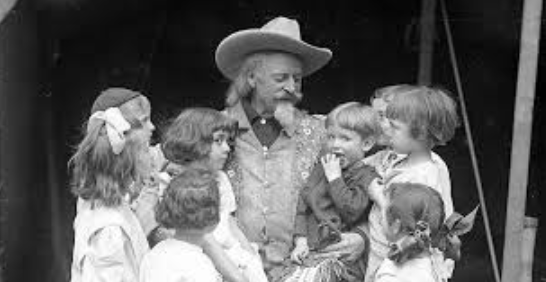
Every family is related to a “famous” person in some way, shape, or form, but for my family, we’re related to the infamous Buffalo Bill. History tells us tales of the bison hunter, who earned his nickname from killing hundreds of American Bison to supply meat for Kansas’ Pacific Railroad workers. Cody became famous after adopting a wild west show featuring live buffalo. His relationship with the beasts was sacred but also complicated, far past just a human/beast bond. As he slayed the buffalo and distributed the meat, he was known to keep a small few for his own performances and even kept some species from going extinct.
However, he wasn’t always a perfect buffalo hunter and showman. William F. Cody (Buffalo Bill) was born in Iowa in 1846, but soon after Cody was born, he and his family moved to Kansas. At a young age, Cody lost his father in a stabbing incident, causing his family to face financial hardship throughout most of Cody’s childhood. From a young age, he had to have adult-like responsibilities, and he was forced to become the breadwinner for his family. Cody’s adult life was not much different. After this, he left home at the ripe age of eleven to herd cattle and work as a driver on a wagon train. As Cody grew older, he became involved in the business of fur trading, animal trapping, and gold mining, before Cody eventually embarked on his army career. After the Civil War, Cody scouted for the army and earned the nickname “Buffalo Bill” as he provided buffalo meat for the nearby railroad workers. Though Cody was known as a local star, it wasn’t until he met dime novelist Ned Buntline, who transformed Cody into a larger-than-life celebrity and turned his life into a show.
His impact on the world at that time was immense. It encouraged viewers to see the Wild West in a newly romanticized way. Previously, most shows focused on the hardships of life in the West, including mosquitoes, swirling blizzards, boredom, drinking, gunshots, and wild wolves. The show shone a light on the myths and magic of the land, showing a truly authentic version of who was living in the area, past their rough and tough outer shells. It dove deep into the hidden truths. But as he became a symbol of “the wild west,” hardships and criticism followed closely behind.

Though he had everlasting fame, Cody faced the varying opinions of the media. As Cody aged, he began to develop a more sympathetic view of the Native Americans. Cody grew brave and actively spoke out about scalping and other atrocities committed against the native people. This was an unpopular opinion, and at the time, it was extremely uncommon for someone like Cody to go against these acts publicly, especially since they had become so normalized. This led to a shift in public opinion against him.
My Great Grandmother once told me a story about Cody, coming home to some of his distant relatives, the Murphys. His great-grandfather turned him down when he tried to come to his house and refused to let him in, labeling him as a “buffalo killer”, showing how his views ostracized him. The Result of Cody’s father’s death at such a young age, he never really had any support for his career from his family. From having to work and be independent from such a young age, he supported his family more than his mother or distant family ever publicly supported him.
Even through hardship, Buffalo Bill became a pioneer of the entertainment industry and provided aid and comfort for hundreds of blue-collar workers. He became a symbol of hard work and opinion as well as a prime example of a man untainted by the media. Cody created an image of the Wild West and pioneered the fundamentals of being a cowboy. He broke social norms and spoke up, defending his point of view on what should have been society’s standards.





 The Golden Trident
Leave a comment